
Popunder Traffic in 2026: Where to Buy It, What It Costs and What Converts
Popunder traffic is cheap, huge and brutally honest. You can buy 100,000 visits in an afternoon, and you’ll know by dinner whether your offer works. The catch? Most people only look at one side of the math. They check what the traffic costs and never ask what it can earn. This guide covers both. You’ll see prices for popunder ads by GEO for 2026, which verticals convert, and a simple break-even check built on our own smartlink data.
Short answer: in 2026, popunder traffic costs about $3-6 per 1,000 impressions in Tier-1 countries, $1.50-4 in Tier-2 and under $1 in Tier-3. It works best for short funnels: utilities, VPN, sweepstakes, dating and iGaming. It pays off when each popunder visit earns at least your CPM divided by 1,000. Below, we’ll show you how to check that before you spend a dollar.
What You’re Actually Buying With Pops
A popunder opens your page in a new window behind the one the user is browsing. They see it when they close or switch tabs. If you need the full basics, we covered them in What Is Popunder in Affiliate Marketing.
Here’s the part that matters for your budget. With most formats, you pay for an impression and hope for a click. With a popunder, the impression is the visit. There’s no banner and no click-through rate in between. Every impression you buy lands a real person (or a bot, more on that later) on your page.
That changes the math. When you buy pop under traffic on a CPM basis, you’re paying per 1,000 visits. And if you send those visits to a smartlink, you can compare cost and revenue directly: what you pay per 1,000 visits against what 1,000 visits earn.
A quick word on terms, because networks use them loosely. “Pop,” “popunder,” “pop-up,” “clickunder” and “onclick” usually describe the same inventory: a new window or tab that opens after a user action on a publisher’s site. Pop-ups open in front, popunders behind, but most networks sell them as one format and price them together.
It also explains the format’s reputation. Nobody asked to see your page. The user was doing something else. So your page has about two seconds to earn attention, and anything that needs thinking, reading or trust-building usually loses.
How Much Popunder Ads Cost in 2026
Pop traffic is sold in a real-time auction, so prices move with demand. Still, the averages are fairly stable. Here are blended 2026 CPMs from Remoby’s Traffic Chart, updated in August 2026:
| GEO | Tier | Average CPM, 2026 |
|---|---|---|
| Australia | 1 | $5.87 |
| United States | 1 | $5.36 |
| Canada | 1 | $4.59 |
| United Kingdom | 1 | $4.57 |
| Germany | 1 | $3.85 |
| Thailand | 2 | $3.99 |
| Philippines | 2 | $3.52 |
| Brazil | 2 | $2.84 |
| Mexico | 2 | $2.28 |
| Indonesia | 2 | $2.02 |
| Vietnam | 2 | $1.55 |
| India | 3 | $0.66 |
The gap between the top and the bottom is almost 9x. That’s normal for popunder advertising: a visitor from Sydney and a visitor from Delhi cost very different money, because advertisers expect very different returns from them.
Desktop vs. Mobile
Desktop pop traffic usually costs more than mobile in the same country. In Tier-1 markets, mobile often clears around $3-4 CPM, while desktop can go past $5-6.
Mobile has more volume and it’s cheaper, but a popunder on a phone behaves differently. There’s no “window behind the window.” It usually opens as a new tab or replaces the page after a tap. If your landing page isn’t built for a small screen, you’ll burn that cheap mobile traffic fast.
CPM vs. CPA Bidding: What to Start With
Most ad networks let you pay per 1,000 impressions (CPM) or per conversion (CPA, sometimes called target CPA or smart bidding).
- Start with CPM. It’s predictable and you control the volume. Networks usually suggest opening at 1.1-1.2x the average CPM for your GEO, so you get enough impressions to learn from.
- Move to CPA later. Once you know which placements convert, CPA bidding lets the network optimize for you. On day one, it has nothing to optimize on.
What Converts on Pops
Popunder visitors didn’t search for you. They were watching a video, reading an article or downloading a file. So the offers that win are the ones people can say yes to in one step.
Verticals That Fit
- Utilities, VPN and antivirus. A simple promise (“your connection isn’t private”) and a one-click install.
- Sweepstakes. Low effort for the user: enter an email or a phone number and you’re in.
- Dating. Especially single opt-in (SOI) offers, where the conversion is a quick signup.
- iGaming. Big payouts and a lot of competition. It works best with a strong prelander in markets where the offer is legal.
- Mobile apps and games. Install offers with a clear hook.
- E-commerce. Flash-sale style offers with one product and one price.
What usually fails: long forms, expensive one-time purchases, and anything that needs the user to read three screens before they understand the offer.
Why Short Funnels Win
Every extra step loses people. On search traffic, a user who wants something will push through a form. On a popunder, they won’t. That’s why popunder ads work best when the whole path is one page, one message and one button.
It’s also why smartlinks fit this format so well. You don’t have to pick an offer for every GEO by hand. On a LosPollos smartlink, direct advertisers and programmatic demand compete for every click in a single auction, and the ad that pays the most right now wins.
Will It Pay Off? The Break-Even Check
Here’s where most guides stop. They tell you what the traffic costs, and that’s it. But price alone says nothing. A $5 CPM can be a bargain or a disaster. It depends on what those 1,000 visits earn.
We publish weekly eCPM reports for our smartlink. eCPM is the revenue from 1,000 clicks sent to a LosPollos smartlink. Since a popunder impression is a visit, you can put the two numbers side by side.
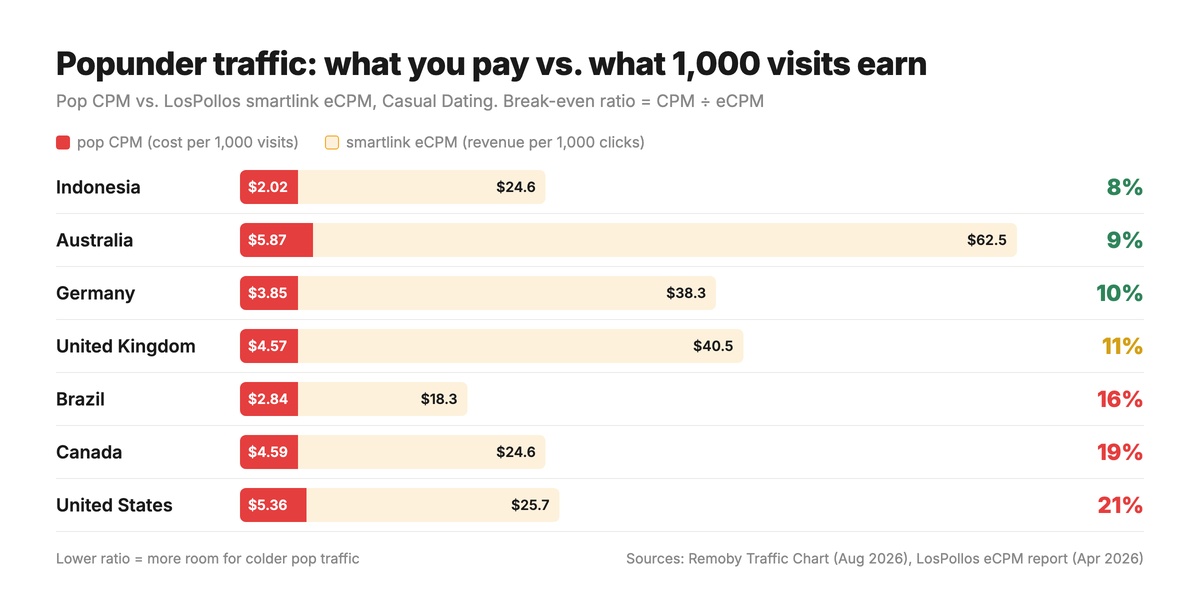
The table below uses the average CPM from above and our smartlink eCPM for two verticals: Casual Dating (April 2026 report) and iGaming (July 2026 report).
| GEO | Pop CPM | Smartlink eCPM, Casual Dating | Break-even ratio | Smartlink eCPM, iGaming | Break-even ratio |
|---|---|---|---|---|---|
| United States | $5.36 | $25.70 | 21% | $29.40 | 18% |
| Canada | $4.59 | $24.60 | 19% | $59.80 | 8% |
| United Kingdom | $4.57 | $40.50 | 11% | $72.50 | 6% |
| Germany | $3.85 | $38.30 | 10% | $48.50 | 8% |
| Australia | $5.87 | $62.50 | 9% | $46.90 | 13% |
| Brazil | $2.84 | $18.30 | 16% | n/a | n/a |
| Indonesia | $2.02 | $24.60 | 8% | n/a | n/a |
| Mexico | $2.28 | n/a | n/a | $96.70 | 2% |
How to Read the Ratio
The break-even ratio is pop CPM divided by smartlink eCPM. It tells you how good your pop visits have to be, compared with an average smartlink click, just to cover its cost.
Take the US in Casual Dating. You pay $5.36 per 1,000 pop visits. An average 1,000 clicks to the smartlink earn $25.70. So your pop visits need to perform at 21% of an average click or better. Below that, you lose money. Above it, you’re in profit.
Now look at Mexico in iGaming: the ratio is just 2%. Even weak pop traffic has a lot of room there. And Canada in iGaming (8%) gives you far more room than Canada in Casual Dating (19%), at the same traffic price.
Be honest with yourself about one thing. Our eCPM is an average across all traffic sources: SEO, social, push, pops and more. Popunder visits are usually colder than the average click, so they’ll earn less than these numbers. That’s exactly why we show the ratio and not a profit forecast. A low ratio means you have room for weaker traffic. A high ratio means your targeting has to be sharp from day one.
The data also moves. Our reports are weekly snapshots, and eCPM can swing a lot from week to week. Check the latest report for your GEO before you plan a budget.
How to Measure Your Real Popunder eCPM
The ratio is a starting point. Your real number comes from a test.
- Pick one GEO and one vertical with a low break-even ratio.
- Buy 20,000-30,000 impressions at a CPM bid near the market average.
- Send all of them to one smartlink with a separate sub-ID for this campaign.
- After 24-48 hours, divide your revenue by the number of visits and multiply by 1,000. That’s your real popunder eCPM.
- Compare it with your CPM. If eCPM beats CPM, start cutting bad placements and scale. If it’s far below, change the GEO or vertical before you tweak anything else.
At $3-5 CPM, that test costs about $60-150. It’s cheap tuition compared with guessing.
One more tip: run the test on weekdays and weekends. Pop inventory shifts with the week, because people browse different sites on a Saturday night than on a Tuesday morning. A GEO that looks weak on Monday can look very different by Sunday.
How to Buy Popunder Traffic: Step by Step
You can buy popunder traffic from dozens of self-serve ad networks. Most work the same way, so the process below applies to almost any of them.
- Pick a network that sells pops in your GEO. Check two things before you deposit: whether it has real volume in your target country and what anti-fraud filters it offers. Most networks show estimated daily impressions per GEO before launch.
- Set a test budget. For Tier-2, a practical rule is enough budget for 30-50 conversions at your target cost. That’s often $300-500. For a first eCPM test, the 20,000-30,000 impressions above are enough.
- Start broad, then narrow. Launch on all placements for one GEO. After the first few thousand impressions, collect the sources that bring conversions (whitelist) and those that burn money (blacklist).
- Cap the frequency. One impression per user per 24 hours is a safe start. Showing the same popunder three times to the same person rarely helps.
- Decide: prelander or direct link. A prelander often lifts conversion on dating and iGaming, because it warms the user up before the offer. For utilities and sweepstakes, a direct link can work just as well. Test both.
- Track by source. Pass the placement ID into your tracker or your smartlink sub-ID. Without it, you can’t tell good sources from bad ones.
Common Mistakes
Judging a GEO by CPM alone. A cheap GEO isn’t a profitable one. India at $0.66 CPM can lose more money than Australia at $5.87 if nothing converts. Always check the revenue side.
Killing a campaign too early. The first 2,000 impressions are noise. Wait for enough data to see which placements work, then cut.
Skipping the blacklist. Pop inventory is uneven. A handful of placements often burn most of the budget. Blacklisting them is the fastest way to improve ROI.
Ignoring bots. Some pop traffic isn’t human. If a source sends lots of visits with zero engagement, zero conversions and weird device patterns, block it. Use the network’s anti-fraud options and check your tracker for anomalies.
Using a long landing page. The visitor didn’t choose to be there. Every extra line of text and every extra field in a form loses people.
FAQ
How much budget do I need to start with pops?
For a first test, about $60-150 buys 20,000-30,000 impressions at Tier-1 or Tier-2 prices. That’s enough to measure your real eCPM. For a full campaign with optimization, plan around $300-500 per GEO.
Is pop traffic full of bots?
Some of it is. That’s true for most display formats. Choose networks with anti-fraud filtering, track by placement, and blacklist sources with suspicious patterns. Real human traffic still makes up most of the volume on reputable networks.
Do popunders work on mobile?
Yes, and mobile is where most of the volume is. It usually opens as a new tab rather than a hidden window. Make sure your landing page or smartlink offers are mobile-friendly.
Should I use a prelander or a direct link?
Test both. Prelanders usually help with dating and iGaming, where users need a little warm-up. Direct links often work fine for utilities, VPN and sweepstakes, where the offer is simple.
Is popunder better than push traffic?
They’re different tools. Push has a click in between and a more engaged audience, and it usually costs more per visit. Pops are cheaper and give you more volume, but colder visitors. If you’re comparing sources, our guide on where to buy push notification traffic covers the push side.
Bottom Line
Pops are one of the cheapest ways to get real visits at scale. In 2026, you’ll pay about $3-6 CPM in Tier-1 and much less elsewhere. But the price only means something next to what those visits earn.
Here’s the short version:
- Check the CPM for your GEO.
- Check the smartlink eCPM for your GEO and vertical.
- Divide one by the other to get your break-even ratio.
- Test 20,000-30,000 impressions to find your real popunder eCPM.
- Scale what beats the CPM, cut what doesn’t.
The lower the ratio, the more room you have to learn. If you’ve been skipping pop under traffic because of its reputation, this check is the cheapest way to find out if it can work for you. Start there.
Get your LosPollos smartlink and test your first popunder campaign →
Disclaimer: The views, opinions, and content expressed in this article are those of the author and do not represent the official position, policies, or endorsements of the company.