

Push Ads – Where To Buy Push Notification Traffic
Push ads are still one of the cheapest ways to drive engagement in affiliate marketing. The push notification meaning is simple: a short message that pops up on a user’s screen, even when they are not browsing your site. This guide covers what push ads are, how push traffic works, the best push notification ad networks to buy from, and which GEOs convert best in 2026.
If you have never tried push, you are leaving money on the table. The format is small, native to the device, and works on both mobile and desktop. Let’s break it down.
- What Are Push Notifications
- What Are Push Ads
- Different Types of Push Notifications – What to Choose
- Why Are Push Notifications Used in Affiliate Marketing
- In Which Verticals Can Push Ads Be Used
- Which GEOs Are Best for Using Push Ads
- Where to Buy Push Notification Traffic – Push Ad Networks
- How to Measure the Effectiveness of Your Push Ad Campaign
- Final Word
What Are Push Notifications
The push notification definition is a clickable message sent directly to a user’s device from a website, app, or ad network. Users see it on their lock screen, notification center, or as a banner at the top of the screen. They do not need to be on your site to receive it.
To define push notification in one line: it is a permission-based message that lands outside the browser tab. The user already opted in, so the message is not spam. That is the whole trick.
What Is a Push Notification Example
Here are common push notification examples you have likely seen:
- A news site sending a breaking story alert.
- A delivery app saying “Your order is 2 minutes away.”
- A casino offers: “200% bonus + 50 free spins. Tap to claim.”
- An e-commerce site reminding you about an abandoned cart.
- A push ads campaign from a media buyer pushing a sweepstake offer.
The first four are owned by push notification marketing. The last is paid push advertising, which is what affiliates buy.
What Is the Difference Between a Push Notification and a Regular Notification
A regular mobile notification comes from an app you installed: WhatsApp, Gmail, Uber. A classic push notification in advertising comes from a website you visited and clicked “Allow” on. No app needed.
That subscription happens through a small browser prompt. Once users click “Allow,” the publisher can keep sending notifications to that device, until the user unsubscribes. Ad networks buy these subscriber lists and resell access as notification traffic.
In-page push is a twist on this. In-page push traffic does not need a subscription, since it shows the message as an overlay on a webpage. It looks like a push but loads inside the browser, which means it works on iOS devices too.
Are Push Notifications Compliant with GDPR?
Yes, if done right. The user must give clear opt-in consent before any provider can send push notifications to their device. Most networks handle this with a standard browser prompt that meets GDPR rules. If you are running campaigns in the EU, check that your traffic source stores opt-in proof and respects unsubscribe requests.
What Are Push Ads
So, what are push ads? They are paid messages, delivered in the same format as a push notification, but bought through an ad network. Affiliates use them to push offers in front of subscribed users on mobile devices and desktops.
Unlike banner ads, push ads do not sit on a page. They arrive when the user is doing something else, which makes them feel personal. CTR is usually 5 to 30 times higher than display, depending on GEO and creative.
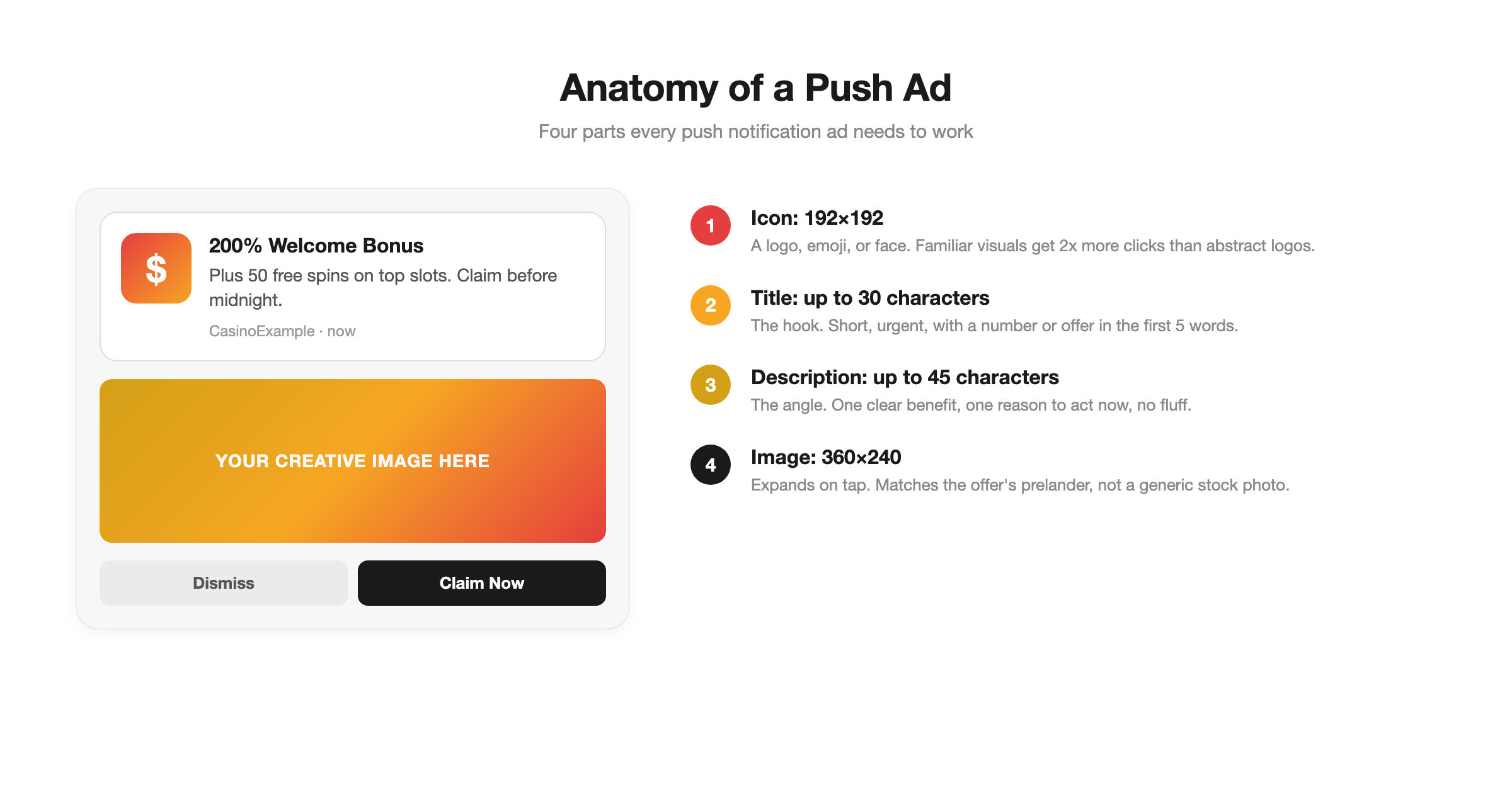
What Do Push Ads Consist Of
Every push notification ad has the same four parts:
- Icon: a 192×192 image, usually a logo or face.
- Title: up to 30 characters that hook the reader.
- Description: up to 45 characters with the offer or angle.
- Image: a larger 360×240 creative that loads when the notification expands.
Some ad formats also include a CTA button. Keep all four elements aligned with one angle. Mismatched copy and image is the fastest way to burn a push campaign.
Push Ads Best Practices for Affiliate Marketers
A few rules affiliate marketers learn the hard way:
- Test 10 to 20 creatives at once, kill losers fast.
- Localize text into the GEO’s language, not just English.
- Match the icon to a familiar emoji or face, not a logo.
- Split traffic by OS, browser, and connection type.
- Refresh creatives every 5 to 7 days, since fatigue kicks in fast.
The goal of any push ad campaign is to read user behavior signals quickly and reallocate budget toward what wins.
What Not To Do When Using Push Ads
Do not use clickbait that has nothing to do with the landing page. The clicks will be cheap, but the conversion rate drops to zero. Do not run the same creative for two weeks straight, since open rate decays after a few days. Do not skip prelanders on cold offers, since most users need a softer entry before the main page.
And do not buy from a random network with no anti-fraud filters. You will pay for bot clicks.
Different Types of Push Notifications – What to Choose
Push has split into a few sub-formats. Here is the short version:
- Classic web push: sent to subscribers via browser, works on desktop and Android.
- In-page push: overlay on a webpage, works on iOS too.
- Native push: styled to match the device’s OS notifications.
- Calendar push: delivered through iOS calendar invites, a workaround for Apple’s push ban.
- App push: sent through a mobile app SDK, used mostly by app owners, not affiliates.
For most affiliates, classic web push plus in-page covers 90% of needs.
Why Are Push Notifications Used in Affiliate Marketing
Three reasons. First, the target audience is already engaged, since they opted in. Second, push notifications marketing scales fast across GEOs. Third, the cost per click is lower than almost any other format, which lets you test offers cheaply.
Push is also one of the few channels where you can run gray-area verticals without instant rejection. Networks have stricter rules in 2026 than in 2020, but the bar is still lower than Facebook or Google.
Why Push Traffic Can Be Cheap
Push traffic is cheap because subscriber lists grow faster than advertiser demand. Publishers collect millions of opt-ins from worldwide users, often from low-cost GEOs. Networks resell access at a low CPC, sometimes $0.001 in Tier 3.
The flip side: open rate and conversion rate vary wildly. You need volume and tight tracking to find the pockets that actually pay.
In Which Verticals Can Push Ads Be Used
Push works best for impulse-driven verticals. The top performers in 2026:
- iGaming and betting: casino bonuses, sports events, and crash games.
- Nutra: weight loss, male enhancement, and anti-aging, with strict compliance.
- Dating – both mainstream and adult, with prelanders.
- Finance: loans, credit cards, forex.
Vertical and GEO go together. A nutra offer that prints in Italy may flop in Brazil, even with similar push ads examples in the creative.
Which GEOs Are Best for Using Push Ads
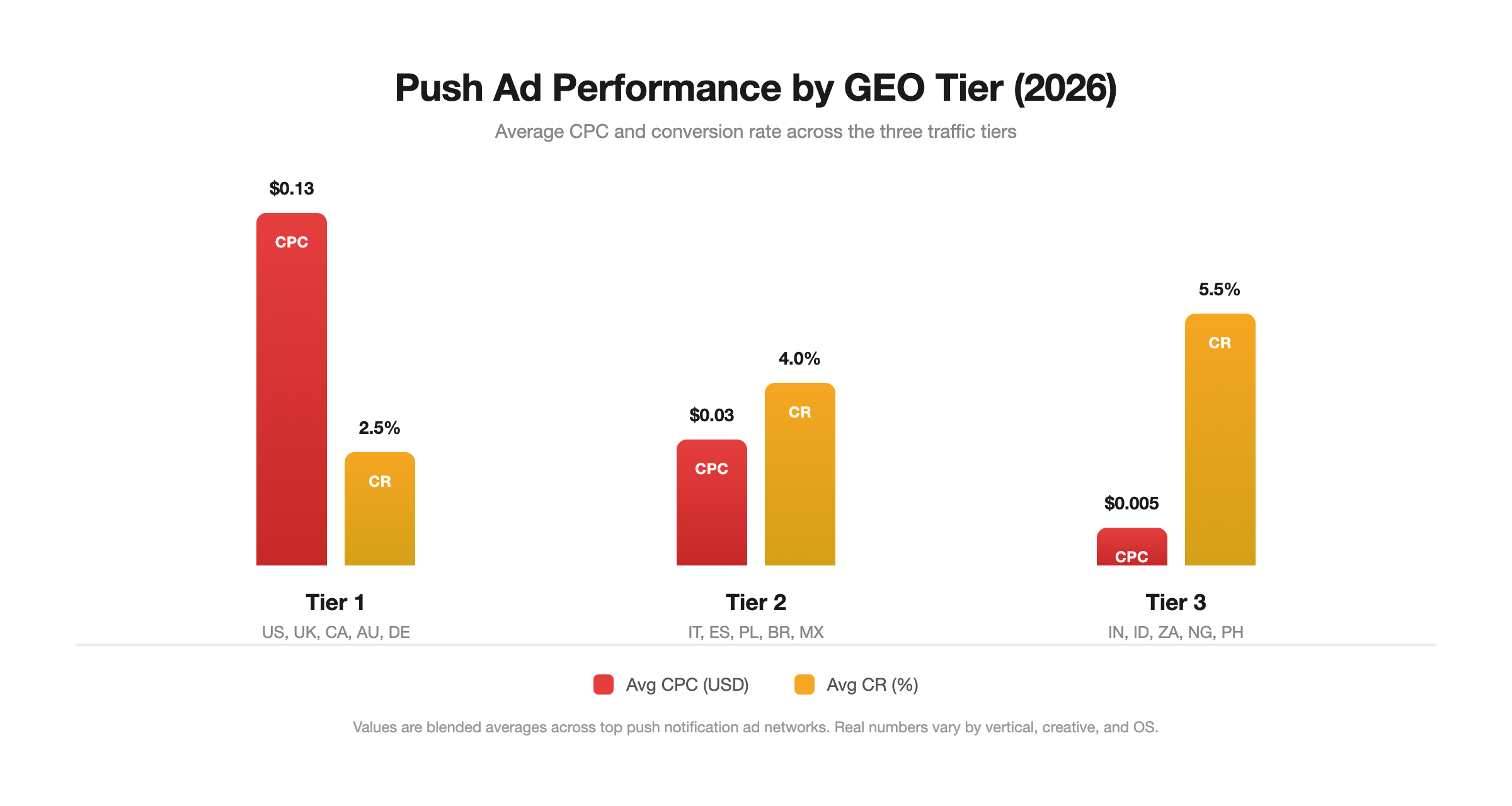
The answer depends on budget. Newcomers usually start with Tier 3 GEOs where CPC is cheap, and traffic is plentiful.
| Tier | GEOs | Avg CPC | Avg CR |
| Tier 1 | US, UK, CA, AU, DE | $0.05–0.20 | 1–4% |
| Tier 2 | IT, ES, PL, BR, MX | $0.01–0.05 | 2–6% |
| Tier 3 | IN, ID, ZA, NG, PH | $0.001–0.01 | 3–8% |
The top GEOs for push notification advertising in 2026 are India, Indonesia, Brazil, the Philippines, and South Africa for volume. For payout per conversion, Tier 1 still wins, but only if your creatives and prelanders are sharp.
Where to Buy Push Notification Traffic – Push Ad Networks
You buy push notification traffic through specialized push notification ad networks. These networks own or aggregate subscriber lists and let you bid on impressions in real time.
The strongest push notification ad network options in 2026:
- PropellerAds: one of the oldest, with a huge inventory and good support.
- MegaPush / MGID: strong in Tier 2 and Tier 3.
- EvaDav: flexible, in-page push included.
- AdMaven: wide format mix beyond push.
- DaoPush: newer but competitive CPC.
When you compare a push ads network, look at minimum deposit, anti-fraud tools, targeting depth (GEO, OS, browser, ISP), and creative approval speed. Avoid networks that hide their push notification advertising network stats behind paywalls.
How to Measure the Effectiveness of Your Push Ad Campaign
You measure a push ad campaign by these core metrics:
- CTR: clicks divided by impressions, shows creative strength.
- Open rate: share of delivered pushes that the user actually viewed.
- CR: conversions divided by clicks, shows offer and prelander fit.
- CPA: cost per conversion, the bottom line.
- ROI: net profit divided by spend, the only number that matters long-term.
Run all mobile push notifications advertising through a tracker like Keitaro, Voluum, or Binom. Tag every click with subID for the creative, GEO, OS, and source. Without subIDs you are flying blind.
Set up postback URLs between your push notification ad networks and your tracker so conversions flow back in real time. Without postbacks, you cannot scale.
Final Word
Advertising with push ads is one of the lowest-risk ways to learn paid media in affiliate marketing. The format is forgiving, the entry cost is low, and the feedback loop is fast. If you treat each notification ads campaign as a controlled test, you will find winning angles within the first few hundred dollars of spend.
Pick one network, one vertical, and three GEOs. Run small, kill losers fast, scale winners hard. That is the whole game.
Start monetizing your traffic with LosPollos. Sign up for free and get access to top offers.
Disclaimer: The views, opinions, and content expressed in this article are those of the author and do not represent the official position, policies, or endorsements of the company.